

What Does a Better Leader Actually Look Like?
Here’s something I’ve come to believe after years of doing this work.
One of the truest signs of a great leader is that most days, their team doesn’t really need them.
Not that the leader is gone or absent. Just that they’re less needed in the day-to-day, because the people around them are competent, confident, motivated, and clear on what they’re doing. The work keeps moving whether the leader is there or not.
That’s a different picture than the one we might sometimes get, where the leader sees themselves as the centre and the team as dependent.
I see leadership at its best when it works the other way around. The team as the centre and the team as independent. The leader’s job is to set the team up to succeed, so the team can actually do the leading – of themselves, each other, the work and the results.
This article is about what that kind of leadership actually looks like in practice: the signs that leadership isn’t working, the three things that make the biggest difference in developing better leaders, and when leadership development works (and doesn’t work).
Signs That Leadership Isn’t Working
The most obvious sign is usually the results. When turnover climbs, productivity drops, morale slips, and the numbers aren’t where they should be, that’s often the first indicator that something’s off with leadership.
But results can mislead you in both directions.
A strong team can still get results with a weak leader. Sometimes their own drive carries them, or their commitment to each other, or how much they care about getting it right.
And a genuinely good leader can miss the numbers for reasons that may not be in their total control and have nothing to do with their direct leadership: an economic downturn, or a market that shifted.
Of course, leaders are ultimately accountable. Results matter, but they’re not the whole story. We can’t necessarily read every good quarter as proof of good leadership, or every bad one as proof of the opposite.
The subtler signs are often more telling.
1. The team falls apart when the leader steps away
This is the big one, and it comes right back to where I started. What happens when you remove the leader?
When they take a real vacation, or get sick, or go on a temporary assignment, does the team keep moving, or does everything stall and pile up?
Can the leader actually take that vacation, or are they fielding calls and clearing their inbox the whole time, working double before they go and double when they get back?
A team that holds together when the leader steps out has usually been set up well. A team that falls apart hasn’t.

2. The leader is focused on the wrong things
Effective leaders put their energy into what they can control and influence.
Less effective ones get caught up in a more negative mindset and what they can’t.
You hear the excuses, the blaming, the deflecting, all the reasons things aren’t working that happen to sit outside their own direct control and influence.
3. The leader is constantly doing the work themselves
There’s a time for a leader to roll up their sleeves and jump in. But if it’s happening consistently, that’s a sign. A leader who’s always doing their people’s work isn’t leading at their highest level. Leadership is about building capability, not becoming the solution. You might be solving today, but you’re limiting tomorrow.
Often this traces back to how the person became a leader in the first place.
In many cases, they were the best technical person, or they’d been there the longest, so they got promoted.
But being great at the work doesn’t make you great at leading the people who do it. It’s like sports. The best players don’t always make the best coaches.
Leading is a different thing altogether: getting the work done through others, rather than doing it all yourself.
Three Components of Better Leaders
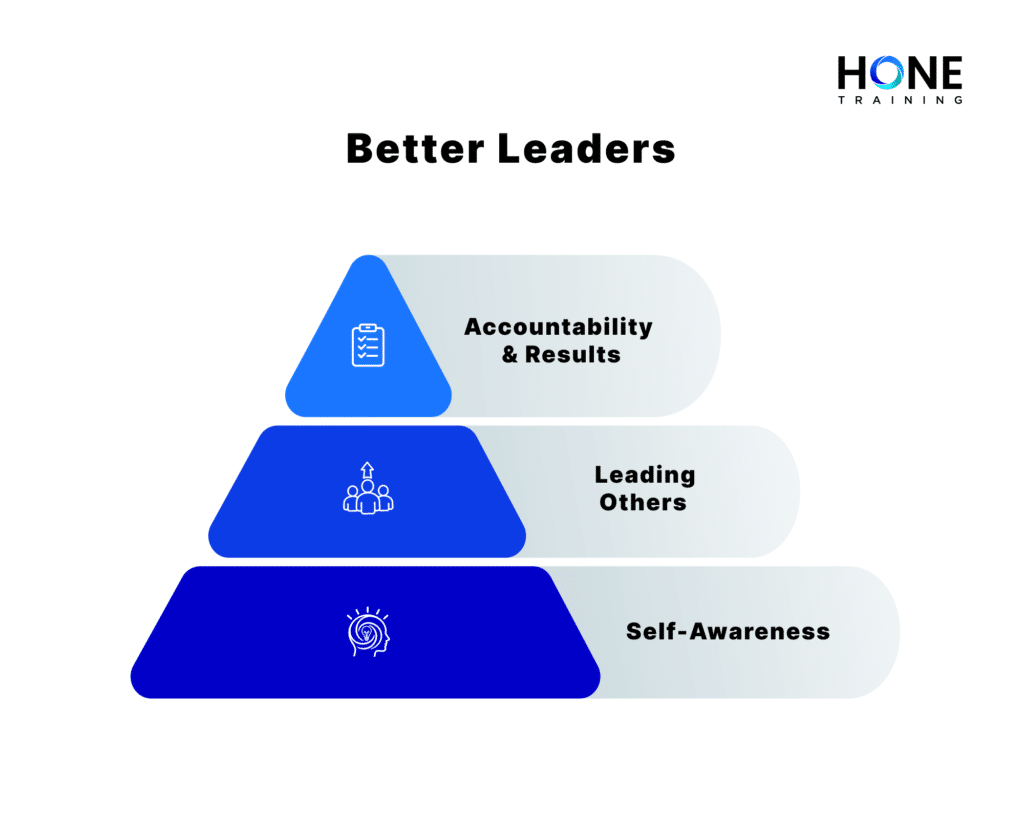
When I work with leaders, I focus on three connected areas: self-awareness, leading others, and accountability and results.
Each one matters on its own, but they build on each other, and the order matters.
You start by becoming more self-aware. Then you learn to lead others. Then you hold yourself and others accountable to results.
Component 1: Self-Awareness
This is where everything starts.
Self-awareness is understanding your emotions, how you communicate, how you handle conflict and change, where your comfort zone is, and where your blind spots might be, as well as your stressors and motivators.
Assessments around communication style, work style, emotional intelligence, conflict, and 360-degree feedback can all act like a mirror, showing leaders something they couldn’t see on their own.
There’s a question that always comes up in personality-style training like DiSC: Which style makes the best leader? The answer is all of them, but only under one condition: the leader has to be willing to step outside their comfort zone by stretching and flexing beyond their own style preferences and tendencies.
I’ve watched that “aha” moment happen in real time. A leader suddenly realizes a relationship has been difficult because they’d never really considered the other person’s needs.
The leaders who often struggle are the ones who plant their flag and say, “This is just how I am,” and aren’t willing to stretch or flex to meet other people where they’re at.
Part of self-awareness is also deciding what kind of leader you want to be. Taking the time to think through your vision for yourself as a leader, how you want to show up, what you hold as non-negotiable, your values, your mission, and the legacy you want to leave.
And it takes a real commitment to never stop learning.
There’s an old line I love, attributed to Ray Kroc: “When you’re green, you grow, and when you’re ripe, you rot.”
The best leaders stay green and have a growth mindset. They keep developing, take care of themselves, model well-being practices, and look after their own resilience because resilient leaders are better equipped to build resilient teams. The moment you think you’ve got it all figured out and start coasting is the moment you might begin to fall behind.
Perhaps the greatest sign of self-awareness is recognizing there’s always more to learn.
The strongest leaders I’ve worked with aren’t the ones who have all the answers. They’re the ones who are comfortable admitting they don’t. They’re willing to say they need development, ask for help, and learn from mistakes.
That may sound like a small thing, but it’s not. Leaders who model vulnerability move through challenges faster and create an environment where others feel safe to do the same.
Component 2: Leading Others
Once you understand yourself and become more intentional about your own self-awareness, the work turns outward.
Leading others is about believing in people’s potential and then creating the conditions for that potential to emerge. At the heart of it all is communication.

Leading others starts with genuinely understanding the people you lead. What makes them tick? What do they value? What’s happening in their lives? What do they need from you as their leader?
There are usually reasons people show up the way they do, many of which are connected to communication and behavioural styles, how we’re wired. That understanding helps build trust, and trust creates the foundation for developing people.
From there, leading others involves a broad range of disciplines: coaching, mentoring, training, delegating, motivating, empowering, leading change, handling conflict, having difficult conversations, and giving feedback. Both the kind that recognizes great work and the kind that addresses what isn’t working.
Many of us grow up believing that a good leader has all the answers and solves every problem. But great leaders build self-reliance. That often means resisting the urge to speak first or jump in with the solution. Instead, they ask thoughtful questions that help people discover their own answers and make their own decisions.
When the solution is theirs, ownership tends to follow. For leaders who are used to having the answers, learning to ask rather than tell can be a genuine turning point.
Underlying all of this is communication. Setting clear expectations, providing direction, checking for understanding, listening well, and adapting your approach to the person in front of you. How a leader communicates touches just about everything else they do.
Component 3: Accountability and Results
The third component is where commitments turn into outcomes. This is often much easier when you’ve invested in the first two.
There’s a phrase I picked up recently that captures it well: care a lot and expect a lot.

When you genuinely care about people, support them, develop them and invest in their potential, you earn the right to hold a high bar and to challenge them to be their best.
Too often, accountability is viewed as blame, punishment, or “holding people accountable.” In reality, accountability is about taking ownership of shared commitments through action, follow-through, progress checks and respectful conversations. It’s doing what we said we’d do, supporting others to do the same, and addressing issues respectfully when we get off track – having the conversations needed to keep yourself and others moving forward.
Teams exist to achieve something together, and accountability is the glue that turns shared commitments into meaningful results.
When leaders genuinely invest in their own development, you see it in the people who report to them.
I’ve run leadership development programs in many organizations over the years, some of them multi-year.
What stands out isn’t any single dramatic moment. It’s the consistency of what shows up with their people.
Engagement scores that are higher and steadier. Positive people metrics. Stakeholders who are more satisfied, whether they’re internal or external.
That’s the return that keeps these organizations coming back. A real, repeated lift in the people around the leader who did the work.
When Leadership Development Doesn’t Work
I’ll also be honest about what doesn’t work, because it’s just as instructive. Not everyone who goes through leadership development comes out better. The difference, almost every time, is whether there’s any accountability afterward.
The real work doesn’t happen in the training room.
There’s nothing magical about a half-day session, or even a year-long program. It can be a powerful start. Foundational. Sometimes genuinely life-changing. But it’s a start.
The workshop is where the learning begins. The workplace is where it becomes real.
The single biggest predictor of whether leadership development sticks is what happens afterward.
The follow-up. The checking in. Asking people what they’ve applied, what’s getting in the way. Trouble shooting and removing barriers.
The most successful teams take the tools they’re given and actually use them, bring them up, and hold each other to them. The ones who don’t, treat the training as a box to check. And not much changes.
A well-developed leader doesn’t just affect their own results. The impact ripples out.
Teams become more self-sufficient. Competent, confident, clear on what they need to do, and able to keep going when the leader steps away.
People feel safe to speak up, ask for help, and admit mistakes, which means problems surface early instead of festering.
And the leader gets to climb out of the weeds and into the work only they can do: vision, strategy, the bigger decisions, clearing obstacles so their people can perform.
The impact a leader has doesn’t end when the workday does. People don’t leave their experiences at work when they go home, nor do they leave their personal lives at the door when they arrive each morning.
The way leaders communicate, develop people, and hold them accountable influences confidence, stress, relationships, and well-being far beyond the workplace. That’s a responsibility, and an opportunity, worth taking seriously.
Where to Start
The most common question I get is, “Where do we start?”
It depends on where your leaders are. What I always recommend first is an honest look at where things actually stand.
That’s what our Better Leaders, Stronger Teams, Healthier Workplaces assessment is built to help you figure out. It covers each of these areas and gives you a clear picture of where you’re strong and where focused development would make the most difference.
Or, if you’d prefer, feel free to book a confidential call to discuss your situation.
Randy Kennett is the founder of Hone Training, where he works with organizations across Canada to develop better leaders, stronger teams, and healthier workplaces through practical, evidence-based training and facilitation. For more than 17 years, he has partnered with government agencies, universities, nonprofits, and private-sector companies to create lasting organizational change.
Related Posts:
Better Leaders, Stronger Teams, Healthier Workplaces
What Does a Healthy Workplace Actually Look Like?
How to Strengthen Your Ability to Team
Better leaders are built, not born. See how Hone develops them.