

What Does a Healthy Workplace Actually Look Like?
Most leaders I work with would say they want a healthy workplace.
But when I ask what’s actually happening day to day, the picture is often different from the picture of health.
People are walking on eggshells. Tensions between teams flare up and never fully resolve. HR is fielding complaints that feel like the tip of a larger iceberg.
Or everything looks fine on the surface — meetings run smoothly, no one’s fighting — but nothing real ever gets said.
This article is about what a healthier workplace actually means in practice: the signs that something’s off, why it gets that way, and the three components that make the biggest difference in turning things around.
Signs That Something’s Off
Some indicators are measurable: grievances filed, harassment complaints, rising absenteeism, stress leaves, turnover you can’t quite explain, employee survey scores that make leadership wince.
I’ve seen cases where leaders are spending 25% or more of their time managing interpersonal drama. That’s more than a full day a week for a 40-hour schedule.
But some of the most telling signs are subtler.
Meetings where everyone nods and nobody says what they actually think. Issues that get discussed in the parking lot but never at the table. People who are physically present but mentally somewhere else.
Patrick Lencioni, author of The Five Dysfunctions of a Team, calls this artificial harmony. Polite, apparently fine, but full of unspoken tensions and elephants nobody names. That kind of workplace can be just as unhealthy as a loud, conflicted one. And in some ways, it’s harder to fix, because nothing looks wrong from the outside.
When I’m assessing a workplace, I’m looking at both layers: the numbers and the quieter dynamics underneath them.
Most workplace health problems trace back to two things: lack of awareness and lack of accountability.
Awareness
I can walk into any organization, ask 30 people how they’d define bullying, harassment, or respect in their workplace, and often get 30 different answers.
That’s what happens when nobody’s ever taken the time to create a shared language.
People show up with whatever communication norms they absorbed growing up or in previous workplaces, and those don’t always align.
Accountability
Even when people know what respectful behaviour looks like, if nothing happens when someone crosses the line, the culture shifts. Disrespect spreads.
The gap between what the organization says it values and what it actually tolerates becomes visible to everyone.
That gap can exist at any level.
Between peers who stay quiet when they witness something off, among leaders who defer difficult conversations, or at the top when culture gets treated as a nice-to-have rather than a leadership responsibility.
Three Layers of a Healthier Workplace
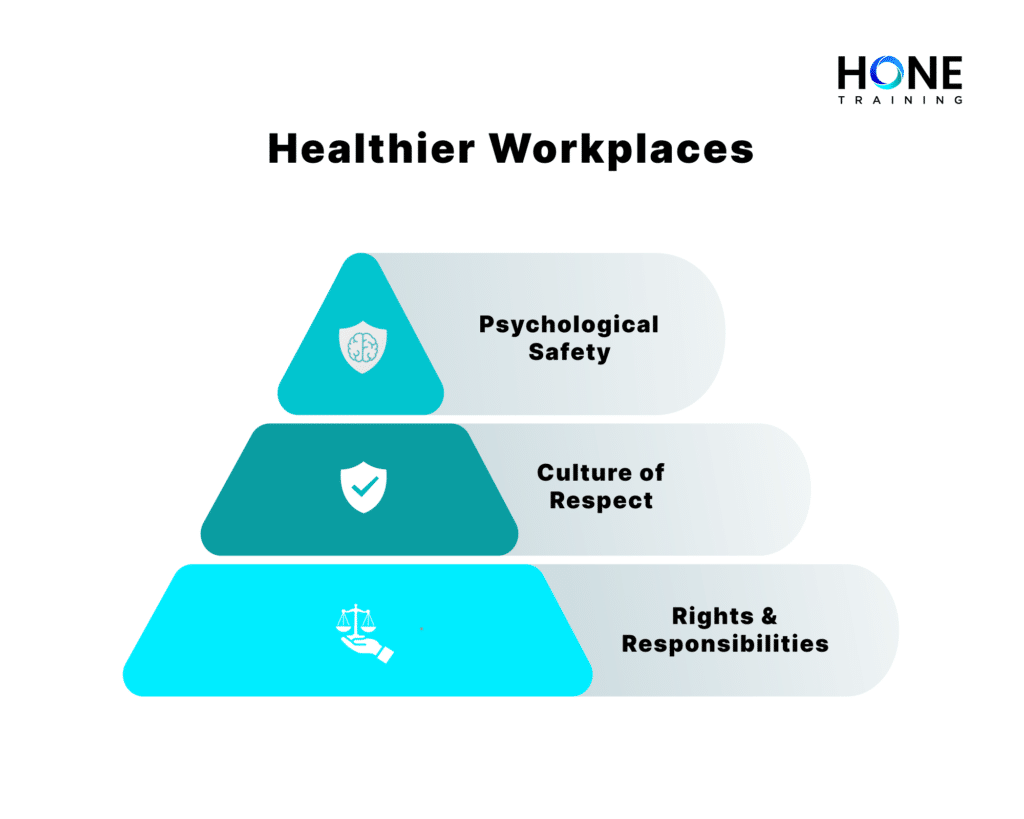
I think of workplace health as a pyramid. Three distinct but interconnected layers, each one building on the one below.
Layer 1: Rights and Responsibilities
The foundation is legal clarity.
Before anything else, people need to understand what bullying, harassment, and discrimination actually mean. Not their personal definitions, but as defined by human rights law, WorkSafe legislation, and organizational policy.
In practice, this means getting everyone in the same room to hear the same definitions at the same time.
I’ve had participants who thought certain behaviours were “just how things are done here,” not realizing they crossed a legal line.
I’ve had others use terms like harassment to describe something frustrating but not legally defined as harassment. This misalignment creates real risk for individuals and for the organization.
I also make a point that surprises people: responsibility for a respectful workplace doesn’t belong only to leaders or HR. It belongs to everyone. And that includes the responsibility to address disrespect when you see it — either by speaking directly to the person involved, or by raising it with the appropriate person. Silence contributes to a disrespectful culture.
Layer 2: A Culture of Respect
Compliance training covers the legal minimum.
The next layer is about defining what respect actually looks like. Because “be respectful” is too vague. You need to be specific about what respectful behaviour actually looks like in your workplace.
In our training, we define respect as engaging in professional ways that promote positive relationships.
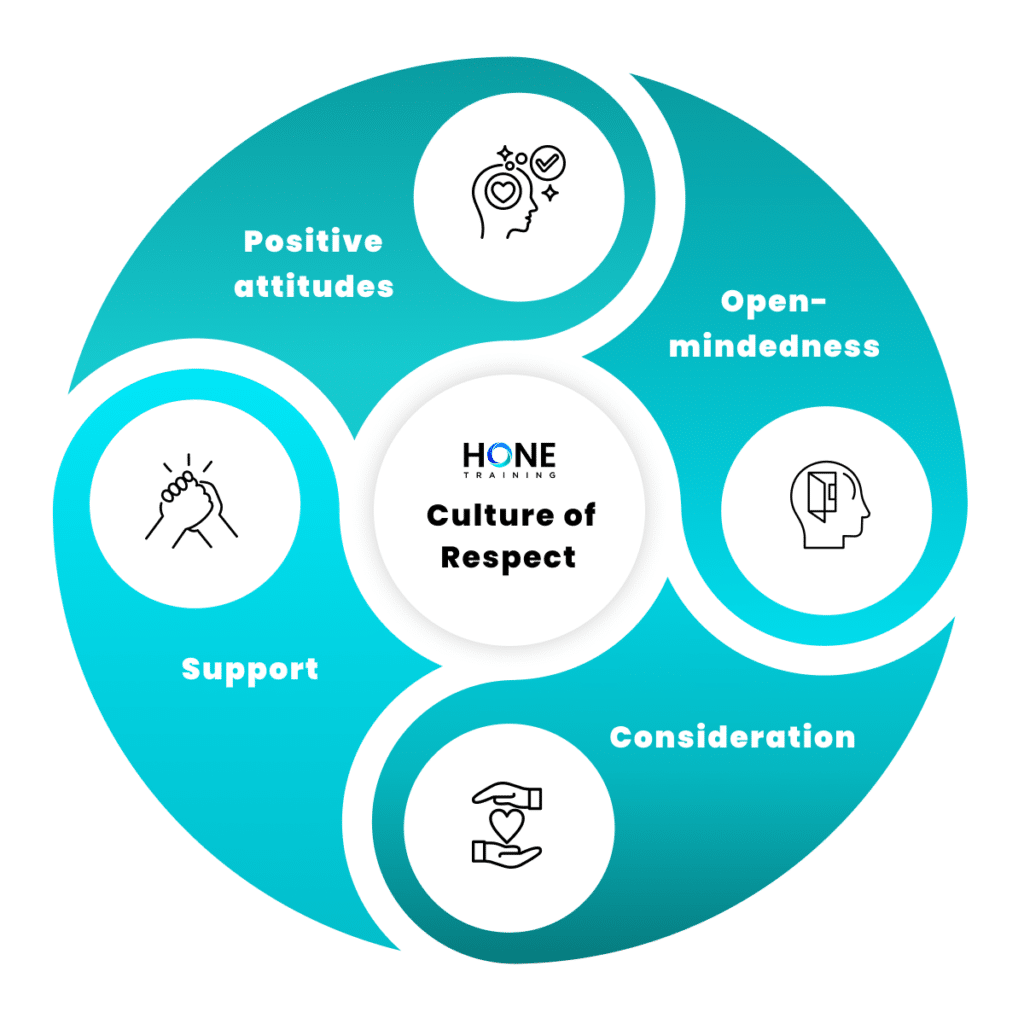
We identify four behaviors that characterize a respectful workplace culture:
- Positive attitudes
- Open-mindedness
- Consideration
- Support
We also name their opposites: negative attitudes, closed-mindedness, disregard, and antagonism.
I use a traffic light continuum to make this tangible: green-light behaviors (respectful, professional) on one end; yellow-light behaviors (disrespectful, needs to be addressed) in the middle; red-light behaviors (legally defined bullying, harassment, discrimination) on the other end.
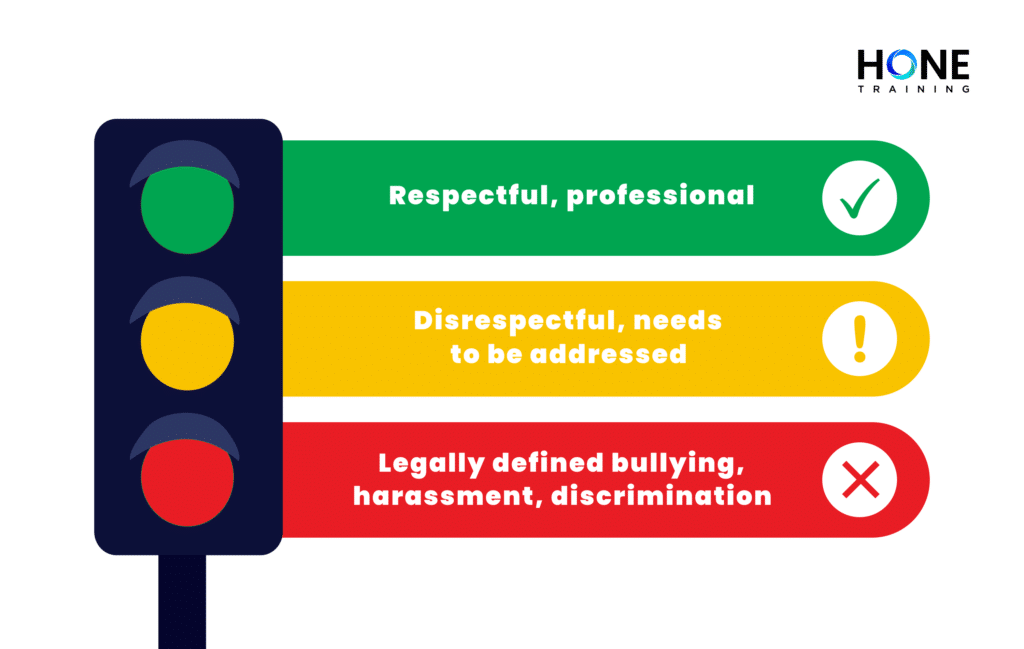
Understanding where those boundaries sit — and being able to name them together — is clarifying in a way that policies rarely are.
Layer 3: Psychological Safety
The third layer is where teams do their best work.
Psychological safety means people can speak up, ask for help, admit mistakes, or share a dissenting view without fear of retaliation or ridicule.
When psychological safety is missing, organizations lose access to their best thinking. People hold back. Problems go unspoken. Improvements go unproposed. And the people with the most to offer often leave first.
Research through the National Standard for Psychological Health and Safety in Canada identifies 13 psychosocial factors — from workload management and recognition to clarity of expectations and involvement in decision-making.
Some of these are team-wide responsibilities. Others fall primarily on leaders. Getting clear on which is which, and building intentionally toward both, is what moves an organization toward genuine psychological safety.
Building the first two layers well — legal clarity and a shared culture of respect — is what makes this layer achievable.
What this looks like in practice – a real example
A few years ago I worked with a mid-sized BC municipality — blue collar and white collar, union and non-union, spanning finance, HR, engineering, parks, water services. The full complexity of local government.
They had a real problem. There was a level of disrespect that had taken root — serious enough I’d use the word toxic. People were uncomfortable coming to work. There were complaints. “Us versus them” ran through the organization.
We started with a full-day session: rights and responsibilities in the morning, respectful workplace behaviours in the afternoon. Everyone heard the same definitions at the same time.
The afternoon was about what respect looks like in action: the attitudes people choose to bring, what it means to stay open-minded, how consideration and support show up in daily interactions.
A year later, they layered on psychological health and safety — working through the 13 psychosocial factors, identifying where they were already doing well and where the work was.
They came out with a shared language and a concrete action plan.
What changed:
Awareness first. Everyone had heard the same message, and they couldn’t say they didn’t know.
That raised personal accountability. People started addressing issues more directly, earlier, before things had a chance to fester. And it set leaders up to have performance conversations when someone consistently didn’t meet expectations.
Now the toxic edge is gone. More positive attitudes, more open-mindedness, more people actually supporting each other. And a foundation they can point back to when things get hard. And it will get hard, because creating a healthy workplace isn’t something you can check off a list. It requires ongoing attention. But the work is worth it.
The benefits of a healthy workplace aren’t abstract. They show up in how people work together every day, and in the results organizations are actually trying to achieve.
When people feel respected and psychologically safe, they contribute more fully.
They raise issues early instead of letting them fester.
They bring real opinions to meetings instead of nodding along.
Diversity of background and perspective stops being a source of friction and starts being a genuine advantage when people actually feel welcome to bring what’s different about them to the table.
At the organizational level: fewer complaints, lower absenteeism, better retention.
Less leadership time consumed by interpersonal drama, so more time can be focused on the work. This also creates a culture where new people can be onboarded into clear expectations — not left to figure out the unwritten rules on their own.
None of that happens because you ran a training. It happens because you built a foundation and keep coming back to it.
Where to Start
The most common question I get: “Where do we start?”
The answer is that it depends. Some organizations need to begin at the foundation with legal clarity before anything else can build on it. Others are ready to go deeper into culture or psychological safety. Many need all three, worked on over time.
What I always recommend first is an honest look at where you actually are. Not where you hope things are, but what’s really happening — in meetings, in conversations, in the gap between stated values and daily behaviour.
That’s what our Better Leaders, Stronger Teams, Healthier Workplaces assessment is built to help you figure out. It covers each of these three areas and gives you a clear picture of where you’re strong and where development will make the most difference. You can take it here: [link]
Or, if you’d prefer, feel free to book a confidential call to discuss your situation.
Related Posts:
Better Leaders, Stronger Teams, Healthier Workplaces
What Does a Better Leader Actually Look Like?
Respect in the Workplace
Healthy workplaces are built on respect. See what our Respectful Workplace Training covers.