

Everything You Need to Know: Frequently Asked Questions About the Everything DiSC® Personality Assessment
Most organizations come to us asking for “the DiSC personality assessment” because someone on the team did it at a previous job, or a leader has heard it helps with communication.
Before anyone commits, the same questions come up. What does it actually measure? Will people end up labelled? How long does it take to set up? What happens after the session?
This page answers those questions, grouped by topic, so you can go straight to the questions you have.
What Everything DiSC® Is
What is DiSC?
DiSC is a model of human behaviour. It describes four basic styles, D, i, S and C, and helps people understand their own style and the styles of the people they work with.
DiSC supports organizations to develop Better Leaders, Stronger Teams and Healthier Workplaces.
People use it for two things. First, to understand how they and their colleagues prefer to communicate and interact at work. Second, to find proven strategies for working together more effectively.
What does DiSC stand for?
Each letter is one of the four basic styles:
- D is Dominance
- i is Influence
- S is Steadiness
- C is Conscientiousness
What’s the difference between DiSC and Everything DiSC?
DiSC is the model. Everything DiSC® is a suite of assessments and training programs that Wiley, the publisher, has built on that model.
When we deliver DiSC, we’re delivering Everything DiSC. The profiles, the online platform and the facilitation materials all come from Wiley. We’re an authorized Everything DiSC partner and certified facilitator.
Is Everything DiSC a personality assessment?
Yes. That’s how most people describe it, and it’s a fair description.
It focuses on one part of personality: your communication and behavioural preferences. How you like to communicate, how you approach your work, and how you interact with other people.
That’s also why teams ask for it. The request is usually for a personality assessment. The need underneath is usually help communicating and working together.
What does DiSC actually measure?
DiSC measures two dimensions of human behaviour. It doesn’t try to cover every aspect of personality.
Pace. At one end are fast-paced people, who tend to be active, bold and dynamic. At the other end are moderate-paced people, who tend to be calm, thoughtful and reflective.
Focus. At one end are logic-focused people, who tend to be analytical, questioning and objective. At the other end are people-focused people, who tend to be empathetic, accepting and warm.
Both dimensions are a continuum, and many people fall somewhere between the two ends.
What are the four DiSC styles?
Put pace and focus together and you get four basic styles:
- D (Dominance): direct, results-oriented, firm, strong-willed, forceful
- i (Influence): enthusiastic, optimistic, outgoing, high-spirited, energetic
- S (Steadiness): even-tempered, accommodating, patient, humble, tactful
- C (Conscientiousness): analytical, reserved, precise, private, systematic
These words describe what’s typical of each style. Two people with the same style can still show up quite differently at work.
How many DiSC styles are there?
There are four basic styles and twelve styles altogether.
Some people have a one-letter style, like D or S. Others have a two-letter style, like DC or iS, because they lean toward two neighbouring styles. A one-letter style is no better or worse than a two-letter style.
I do a bit of everything depending on the situation. Don’t I have all four styles?
Yes. Every one of us has all four styles, and it’s true that your approach changes with the situation. You should be moving between styles as the situation calls for it.
Most people still have one style they’re most comfortable in. If you could work in your ideal world, it’s the one you’d lean toward. That’s your comfort zone.
What does “comfort zone” mean in DiSC?
Your comfort zone is your home base: the style you’re most at home in when you communicate, work and interact with people. It’s where you go by default, especially when work is fast-paced and stressful and everything feels like a priority.
It describes your preferences and tendencies. You’re still capable of working in every other style.
What are DiSC priorities?
Priorities show where you tend to focus your energy at work, in communication and in relationships. They appear as words around the outside of the DiSC circle. (You can see them on the circle in this sample Everything DiSC Workplace profile.)
Everyone has the three priorities closest to where their dot sits on the circle. A typical D style, for example, has action, results and challenge. A typical i style shares action with the D style and adds enthusiasm and collaboration.
Depending on how you answer the questionnaire, you might have a fourth or fifth priority as well. More priorities don’t make you better. They add detail to the picture of your style.
Say an i style also has accuracy as a fourth priority. That describes someone who is enthusiastic and collaborative, and who also sees themselves as quite analytical and logical. You wouldn’t see that in the letter of their style. You see it in their priorities.
Why does my dot sit in a different place than a colleague with the same style?
Your dot’s position shows more than your style letter. Two people with a D style can sit in different places on the circle. One might be close to the centre, the other near the outer edge.
A dot near the edge usually means a stronger inclination toward that style. A dot near the centre means a milder one. Add in your number of priorities and whether you have a one- or two-letter style, and no two D styles (or i, S or C styles) are exactly alike.
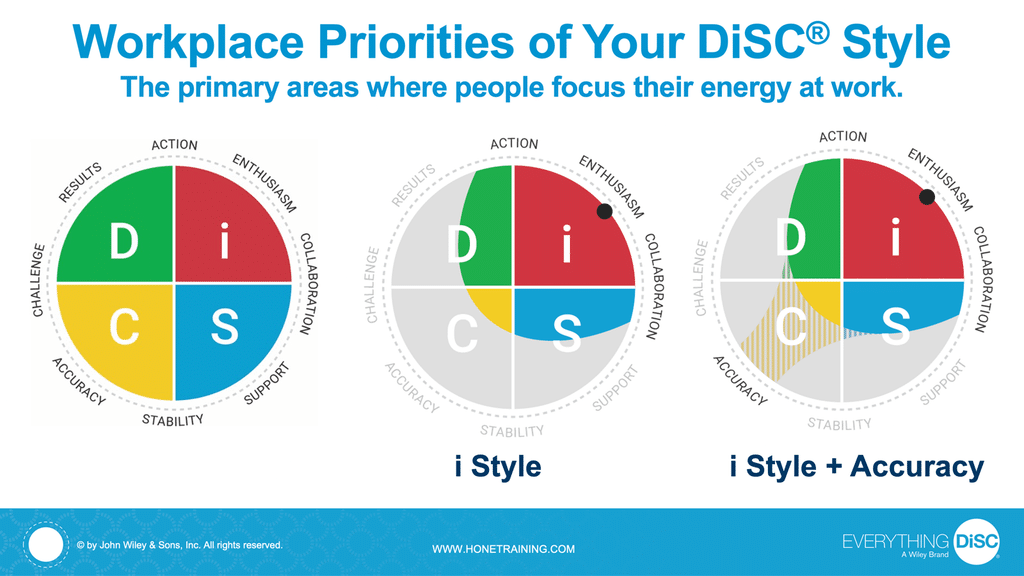
To see what this looks like, the sample Everything DiSC Workplace profile shows a dot on the DiSC circle with the priorities around it.
The Assessment Itself
How do I take the Everything DiSC assessment?
You complete an online questionnaire. Once your organization has arranged the assessment, you’ll receive an email with a link to it.
We call it a questionnaire on purpose. There’s nothing to pass or fail.
How long does the DiSC questionnaire take?
About 15 minutes for most people, and a little more or less for some.
Are there right or wrong answers?
No. There’s no right or wrong, and no good or bad result. Answer based on how you tend to behave at work, not how you think you should.
Why did I get different questions from my colleague?
Everything DiSC uses adaptive testing. The questionnaire adapts some of its questions based on your answers, so not everyone answers exactly the same set.
It adapts in two situations:
- When your answers for one style are inconsistent. If you strongly agree with some characteristics of a style and strongly disagree with others, it asks more questions about that style to find out which end of the spectrum you’re closer to.
- When your answers are tied between two styles. If you’re answering equally for two styles, say S and C, it asks tie-breaker questions to find out which one is more of a comfort zone for you.
This gives you a more precise and personalized result than a fixed set of questions could. Wiley’s Everything DiSC research report explains how the adaptive testing works.
Is Everything DiSC scientifically valid?
Yes. Wiley has more than 40 years of research behind Everything DiSC. The assessment has been tested for reliability and validity, the two measures any psychometric tool has to meet.
The DiSC model is about a century old. It traces back to a 1920s book by psychologist William Moulton Marston. The underlying psychology hasn’t changed much in that time. The assessment has been revised and improved many times over the decades.
If your team wants to review the evidence, you can read Wiley’s Everything DiSC research report on validity and reliability.
What happens to our employees’ names and email addresses?
They’re only used to send out the questionnaires. We don’t add anyone to our mailing list, and Wiley doesn’t add anyone to theirs.
Your DiSC results
What’s in an Everything DiSC Workplace profile?
Your profile is a personalized report built from your answers. It covers:
- Your own style. The priorities that drive your behaviour, your preferences and tendencies in how you communicate and work, and what comes naturally to you.
- The other styles. How to recognize the other styles, how your style tends to react to each of them, and what you may find challenging with someone whose style is different from yours.
- Strategies. Specific ways to stretch and flex outside your comfort zone so you can work more effectively with every style.
You can see the full layout in this sample Everything DiSC Workplace profile.
When will I see my results?
Your organization decides. There are three options:
- Right away, as soon as you finish the questionnaire
- A few days before the session
- In the session itself
Each option has benefits. Most organizations choose immediate access because it builds anticipation. People read their own profile, then start looking up colleagues, and they come to the session interested. It also gives the styles who like processing time a chance to think before the group conversation.
The drawback is timing. Someone who reads their profile weeks ahead and disagrees with it has to wait until the session to talk it through.
What if I don’t agree with my results?
It happens less than people expect. According to Wiley’s research, more than 90% of people agree with their results.
We see only a handful of people a year, across all of our sessions, who feel their profile isn’t them. When someone retakes the questionnaire, they often get the same style again.
If you disagree, use the profile as a starting point. When about half or more of it sounds like you, it’s most likely the right comfort zone. Bring the rest to the session, where it can be discussed.
Will DiSC put me in a box?
This is the concern we hear most, and it comes from people of every age and in every kind of role.
DiSC doesn’t define who you are. It shows which styles come most naturally to you, and you’re capable of all four. Read the descriptions of all four styles and you’ll probably recognize yourself in parts of each.
We also ask people not to use styles as labels or stereotypes. A comment like “you’re being so S today” is the habit we want teams to avoid. The more accurate way to say it is that someone has S style preferences and tendencies.
Is one DiSC style better than another?
No. Every style is equally valuable and important. We make this point clearly and often in every session, because the fear of being judged is behind much of people’s hesitation.
What’s the best DiSC style for leadership?
There isn’t one. Leaders of any style can be highly effective on one condition: they stretch outside their comfort zone.
Leadership asks for all four styles at different times:
- Sometimes a leader needs to be direct, firm and fast-paced.
- Sometimes a leader needs to be supportive, caring and patient.
- Sometimes a leader needs to be enthusiastic, collaborative and optimistic.
- Sometimes a leader needs to be analytical and skeptical, and challenge ideas and risks.
No single style works for every person in every situation. A leader who always works from their own comfort zone will connect with some people and miss others.
I am who I am. Can DiSC actually change anything?
Your DiSC style describes preferences and tendencies. Skills and abilities are a separate question, and DiSC doesn’t measure them. So your style doesn’t limit what you’re able to do.
People work outside their comfort zone all the time and get good at it. We once worked with a VP of finance whose style was i, the style people least associate with finance. She had a long, successful career there because she could stretch into detail, logic and facts when the work required it.
DiSC makes you aware of when you’re stretching and why, so you can do it on purpose.
Can I use my style to explain how I behave?
To explain it, yes. To excuse it, no.
One of the biggest mistakes people make is using their style as a reason for poor behaviour. Each style has its own version:
- D style: “I’m direct and blunt, that’s just how I am.” Sometimes a direct person needs to slow down, think about the impact of their words and let others speak first.
- i style: “I’m a people person.” Sometimes an enthusiastic person needs to cut the chat short so the group can get to the agenda.
- S style: “I don’t like conflict.” Sometimes a patient, accommodating person needs to raise the problem everyone else is avoiding.
- C style: “I need all the details first.” Sometimes a careful, analytical person needs to make a call with the information available.
Each of those is a preference, and on a team, none of them works for everyone.
Do certain DiSC styles suit certain careers?
No definitive research connects DiSC styles to particular careers or industries.
Some patterns do show up. You may see more C styles in engineering and accounting, more S styles in supportive healthcare roles like nursing and social work, and more D and i styles in sales.
Every style shows up in every sector, though. For every team we’ve seen that leaned heavily toward one style, we’ve seen another team in the same sector that leaned toward a different one.
Should we use DiSC for hiring or promotion decisions?
We don’t recommend it. DiSC tells you how a person prefers to work. It can’t tell you whether they have the skills for a role, so screening candidates with it gives you misleading information.
After someone has been hired, it’s useful. DiSC during onboarding helps a new person and their team get to know each other from day one.
Can my colleagues see my DiSC results?
On Catalyst™, Wiley’s online platform, colleagues who have also done DiSC can compare their style with yours. They see where you sit on the DiSC map, your priorities, what matters to you and what tends to cause you stress.
Your full profile stays private to you.
Some people are nervous about sharing their style, usually because they’re worried about being stereotyped or judged. If you expect that on your team, tell us before the questionnaires go out, and we’ll address it with the group.
There is also an option in settings that allow users to make their profile private. We advise against this because it impacts the effectiveness of people learning and understanding you and your needs and preferences, making it more difficult for them to be able to stretch to meet your needs.
Using DiSC with your team
How do we know if DiSC is right for our team?
DiSC tends to help most when you see one or more of these:
- A new team, a new leader, or both. DiSC helps the group get to know each other quickly and build working relationships from the start.
- Someone isn’t aware of their own behaviour. It’s having a negative effect on the team, the people they lead or the culture.
- Communication keeps breaking down. Misunderstandings, disagreements and conflict aren’t getting resolved.
- People are judging each other. Nobody is giving anyone the benefit of the doubt or assuming good intentions.
- Working styles are very different, and nobody has said so. People communicate and approach work differently, and it’s never been acknowledged.
Teams often describe this as a personality clash, or two people who just aren’t on the same page. DiSC gives them a way to see the differences in communication and behavioural style behind it.
What results can we expect from DiSC training?
The aim is a team where people understand how their colleagues prefer to communicate, and adjust for it. Specifically, we look for:
- Better self-awareness
- Clearer communication and stronger working relationships
- Less unproductive conflict
- People adapting their approach to meet each other’s needs
- More trust, cohesion and collaboration
- A common language for talking about how people are similar and different
Less unproductive conflict doesn’t mean less conflict. The best teams still disagree, debate and share ideas. They do it productively.
What does “stretch and flex” mean?
To stretch and flex is to work outside your comfort zone style so you can meet someone else closer to theirs. Your style stays the same. You adjust your approach for a particular person or situation.
It applies to both DiSC dimensions:
- Pace. A fast-paced person slows down for a colleague who needs time to think things through. A moderate-paced person speeds up when a decision can’t wait.
- Focus. A logic-focused person takes a few minutes to connect before getting down to business with a colleague who values the relationship. A people-focused person brings more detail and data for a colleague who is more analytical.
Most of the time, neither person moves all the way. Each stretches a little and they meet somewhere in the middle. That give and take is what creates a culture of communication that works for everyone.
It’s also the phrase that sticks. When we go back to an organization months after a session, people are still using it: you’re here, I’m there, so I’ll stretch and flex to meet you.
How does DiSC help a team build trust?
Most of us stand in judgment until we understand. Once you know why a colleague communicates or behaves the way they do, you’re more likely to give them some grace.
The colleague you took for disengaged was thinking it through. The one you thought was angry with you was being direct.
DiSC also helps people see that their intentions and their impact don’t always match.
Moving a team from judgment to understanding is one of the main drivers of trust. That’s why DiSC sits in the Stronger Teams pillar of our Better Leaders, Stronger Teams, Healthier Workplaces framework. It also builds self-awareness, which is where Better Leaders begins.
What happens in a DiSC workshop?
Each session opens with its purpose: a culture of communication and behaviour that works for everyone. Participants then go through their own profiles and learn how each of the four styles tends to show up.
Much of the session is interactive. In one activity, participants split into four groups by the first letter of their style. Each group spends about ten minutes listing what makes a great day at work for their style and what makes a bad one, then reports back to the room.
A common realization is that one style’s best day is another style’s worst day. The discussion then moves to what the team can do about it. How can we give each other more good days? And how do we accept that each of us will sometimes need to do things from our bad-day list?
How long is a DiSC session?
We recommend a half day, about four hours, as the minimum. A full day gives the group more room to apply what they’ve learned.
Four hours is enough for most groups to grasp the model and begin applying it right away.
Can DiSC be delivered online?
Yes. We deliver DiSC in person and online, for a single team or across several locations.
Is DiSC only for large organizations?
No. Group size ranges from a single team of six up to entire organizations of several hundred. Our clients include government, health authorities, universities, nonprofits and private companies.
Can DiSC be used for one-on-one coaching?
Yes. The questionnaire and profile work in individual coaching as well as in a group session.
What if someone on the team won’t meet anyone halfway?
DiSC depends on everyone being willing to understand each other’s differences and adjust toward one another.
If one person always needs things their way, the session can still be worth running. DiSC alone won’t change that person, though. The first question is whether they’re coachable and able to put on their “reasonable person” hat. If they aren’t, a coaching conversation will likely do more than training.
After the session: Catalyst™ and comparison reports
What is Everything DiSC on Catalyst™?
Catalyst is Wiley’s online learning platform for Everything DiSC. Everyone who completes the Everything DiSC Workplace on Catalyst questionnaire gets an account.
On Catalyst, people can revisit their profile, look up colleagues who have done DiSC, build team maps and find more resources for applying DiSC at work.
How long do we have access to Catalyst?
Indefinitely. It’s included with the assessment. Your organization can add new people as they join and remove people as they leave.
What is a DiSC comparison report?
A comparison report puts two people’s DiSC styles side by side and gives them specific strategies for working together.
In the session, people learn general strategies for each style. A comparison report is more specific. It takes into account each person’s exact spot on the DiSC map, whether their style has one letter or two, and how many priorities they have. It also shows where each person falls on a set of personality traits, such as accommodating versus strong-willed. Here’s a sample comparison report.
On Catalyst, the colleague section has replaced comparison reports. It does everything they did and more, and people can pull up any colleague who has done DiSC on their own, without anyone generating a report for them.
Can we still get comparison reports without Catalyst?
Yes. We can still produce comparison reports for organizations using the standard version of Everything DiSC Workplace.
What does the colleague comparison show?
Choose a colleague, and Catalyst shows:
- Where each of you sits on the DiSC map and how many priorities you each have
- What your colleague cares about and what tends to stress them
- How the two of you are similar and different
- Where you each fall on traits such as accommodating and strong-willed
It then gives you tips for working with that person, including:
- Handling tension or conflict between you
- Connecting and building the relationship
- Working together on a project
- Getting their support for an idea
Catalyst also has a Get Advice section. If you’re dealing with a particular situation, like a conflict with a colleague, you can look them up there and get ideas for working through it.
How should we use colleague comparisons day to day?
These are the uses we see make the biggest difference:
- Before one-on-ones. A leader and a direct report look at their comparison together. Where can each of us adjust? What would you like me to do more of, less of or differently?
- When two people are in conflict. The comparison often points to something neither person had recognized, such as one of them being fast-paced and the other moderate-paced.
- When planning a meeting. Check which styles will be there. A D style might prefer a memo to a meeting. An i style likes a little time to chat and connect at the start. An S style is paying attention to whether everyone’s voice is heard. A C style is looking for the agenda, the data and the reasoning behind decisions.
- When someone new joins. If they do DiSC as part of onboarding, the team and their leader can start building a working relationship with them from day one.
- When people from different departments work together. Someone in marketing and someone in HR may never have been in the same session, but they can both look each other up on Catalyst.
Is it okay to look up a colleague’s style?
Yes. On Catalyst, everyone knows the information is available, and that’s the idea.
The key is to use it as the start of a conversation. Rather than reading a colleague’s comparison and changing your approach without a word, check with them. “This says you might like more detail up front. Is that right for you?”
Sometimes the answer is yes. Sometimes it’s “Not really, I’d rather you did this instead.” The comparison describes what’s typical of a style. Each person’s skills, experience and maturity shape how they show up.
For example, most people with an S style don’t enjoy conflict. Many S styles will tell you that’s no longer true for them, because they’ve built the skills for it and see it as part of their job.
How do we keep the learning going after the session?
We offer to facilitate a virtual check-in between 30 and 90 days after the session. The group talks about how they’re applying what they learned, celebrates what’s working and works through what’s getting in the way.
This also is a good time to explore how you can go further with DiSC with another program like Agile EQ, Productive Conflict, or Worksmart.
Beyond that, Catalyst is the main tool, and the teams that benefit most keep coming back to it. They check it before meetings and one-on-ones, and they add new team members as they join. When teams stop logging in, the same communication problems tend to return.
Choosing an Everything DiSC® program
Which Everything DiSC assessment should we start with?
Everything DiSC Workplace® on Catalyst, in almost every case. It’s designed for every person in an organization, regardless of title or position. It’s also the most widely used Everything DiSC assessment by a large margin.
What’s the difference between Everything DiSC Workplace and Workplace on Catalyst?
The assessment is the same. Workplace on Catalyst adds the online platform: the colleague section, team maps, Get Advice and ongoing access for everyone. That’s why we now recommend the Catalyst version to nearly every client.
With standard Workplace, people receive their profile without the platform, and comparison reports need to be generated for them.
Do we need Everything DiSC Workplace before the other programs?
For add-ons on Catalyst, yes. Worksmart, for example, only works once people have completed Workplace on Catalyst.
For the other programs, no. A team can start directly with Agile EQ™, Management or Productive Conflict.
What other Everything DiSC programs are there?
Everything DiSC® Agile EQ™ teaches people to read what a situation needs emotionally and interpersonally, and to respond to it even when that means working outside their comfort zone. Participants learn about the instinctive mindsets behind their reactions, find their EQ strengths and commit to strategies for becoming more agile. Participants get a 26-page profile and a half-day training session. It’s a natural next step after Workplace, because it goes deeper into what stretching and flexing looks like.
Everything DiSC® Productive Conflict combines DiSC with cognitive behavioural theory. Participants look at how their style shows up in conflict, the destructive behaviours they fall into and the productive ones they can choose instead. The profile is 22 pages. It’s a good fit for teams whose disagreements get personal, or never get said out loud.
Everything DiSC® Management applies DiSC to key management behaviours: directing, delegating, motivating others and developing others, plus working with your own manager. Managers see how their style affects their decision-making, time management and problem solving, and they learn to adapt to each direct report. The profile is 27 pages.
Everything DiSC® Work of Leaders® is designed for senior leaders. It frames leadership as a process of vision, alignment and execution.
Everything DiSC® Sales helps salespeople understand their customers’ styles and adapt to what each customer prefers and expects.
Everything DiSC® Worksmart is an add-on to Catalyst for leaders. It applies DiSC to specific situations: giving feedback, navigating conflict, navigating change, motivating others, and helping others take more ownership of their work.
Everything DiSC Workplace® Certification is for organizations that want their own facilitators to deliver DiSC internally. It combines self-directed online learning with live sessions, and graduates earn the credential of Certified Everything DiSC Workplace® Facilitator.
What comes after DiSC?
For many teams, DiSC is the first piece of work we do together. Common next steps are Agile EQ, Productive Conflict or The Five Behaviors®.
How does DiSC relate to The Five Behaviors®?
The Five Behaviors is a team development program based on Patrick Lencioni’s work. It uses DiSC styles to help teams build the first of the five behaviours, which is trust.
Sharing your style with your team is a form of vulnerability. Every style has strengths, and every style has things to watch for, like leaning on your default approach instead of stretching. Talking openly about both helps a team build vulnerability-based trust.
How is DiSC different from Myers-Briggs or Insights?
There’s a saying we often come back to: all personality assessments are flawed, and most are useful in some way. None of them is a perfect picture of who someone is in every situation.
Our focus is leadership and teamwork, and that’s why we picked DiSC. In our view, its psychology runs as deep as any other assessment’s, and it has been tested to the standards expected of a psychometric tool.
The difference is simplicity. Myers-Briggs gives you a four-letter combination. DiSC gives you four main styles on one circle. I sit here, you sit there, and the model shows what that difference means for working together.
That simplicity makes it easier for teams to remember and keep using in meetings, one-on-ones, decisions and projects. If your organization already uses Myers-Briggs or Insights, you don’t have to choose. DiSC can be used alongside either one.
Getting Started
How do we get started with DiSC?
The process usually looks like this:
- We confirm what success looks like. What should be different after the training, and how will you know?
- We set a timeline working back from your session date.
- You provide participant names and email addresses.
- Someone in your organization tells participants what’s coming. What it is, why you’re doing it, and that an email from us with a link to the questionnaire is on its way. We’re happy to write this message for you.
- Participants complete the questionnaire. We send reminders and update you on how many people have finished.
- You choose when people get their results.
- We prepare the reports and deliver the session.
- We check in 30 to 90 days later to see how people are applying what they learned.
How far ahead do we need to plan?
Four weeks from start to session day gives you a comfortable cushion:
- Two weeks for people to complete the questionnaire
- One week to follow up with anyone who missed the deadline
- About a week to prepare and print the reports
It can move much faster when it needs to. One client had a session booked for the following week. The questionnaires went out that day, participants had until the end of the week to finish, and the session went ahead as scheduled.
Can we buy the DiSC assessment without a workshop?
Yes. You can buy Everything DiSC three ways:
- Facilitated training. We deliver the session, in person or online.
- Assessment and profile only. People complete the questionnaire and receive their profile, with no session. Individual profiles are available through our online store.
- Facilitation kit. Your own trainers deliver the session in-house.
You can also pair the assessment and profile with one-on-one coaching rather than a group session.
How much does Everything DiSC cost?
It depends on the program, the number of participants and how you want it delivered (a facilitated session, the assessment on its own or a facilitation kit).
You can review our approach to pricing and get a quote here.
Can we see a sample report?
Yes. Here’s a sample Everything DiSC Workplace profile, and a sample comparison report between two colleagues.
If you’d like to look at the research behind the assessment, you can also read Wiley’s Everything DiSC research report.
Find out whether DiSC® fits your team
If you’re considering DiSC, tell us what’s happening on your team. We’ll tell you whether DiSC is a good fit, which program makes sense to start with, what it would cost and how much lead time you’d need.
Randy Kennett is the founder of Hone Training, where he works with organizations across Canada to develop better leaders, stronger teams, and healthier workplaces through practical, evidence-based training and facilitation. For more than 17 years, he has partnered with government agencies, universities, nonprofits, and private-sector companies to create lasting organizational change.
More on DiSC, personality styles and moving your team from judgment to understanding
Developing Self-Awareness with a Personality Assessment A closer look at how pace and focus shape the four DiSC styles, and why two colleagues can keep missing each other without either one doing anything wrong.
Two Reasons for Teams to Learn About Personality Styles How learning about personality styles gives people more confidence with each other and helps them take things less personally.
How to Strengthen Your Ability to “Team” Why people misreading each other’s styles is one of the most common reasons a team stops working well. Includes the story of a leadership team that worked on communication styles over several years to move from judgment to understanding.
What Does a Better Leader Actually Look Like? Self-awareness as the starting point for leadership, and why the leaders who struggle most are the ones who say “this is just how I am” and won’t stretch.
The Real Cost of Not Investing in Your Teams The research on what team development returns, including a study showing a 150% ROI from DiSC through reduced turnover.
Team Assessment: The Five Behaviours of a Cohesive Team™ Report What’s in The Five Behaviours team report, including the personality section built on Everything DiSC.
Everything DiSC Comparison Reports The traits a comparison report measures for two colleagues, and how coaches and small groups use it to find strengths, potential friction and strategies for working together.
Better Leaders, Stronger Teams, Healthier Workplaces: A Framework for Organizational Development The framework behind all of our work, and where self-awareness and moving from judgment to understanding fit within it.